
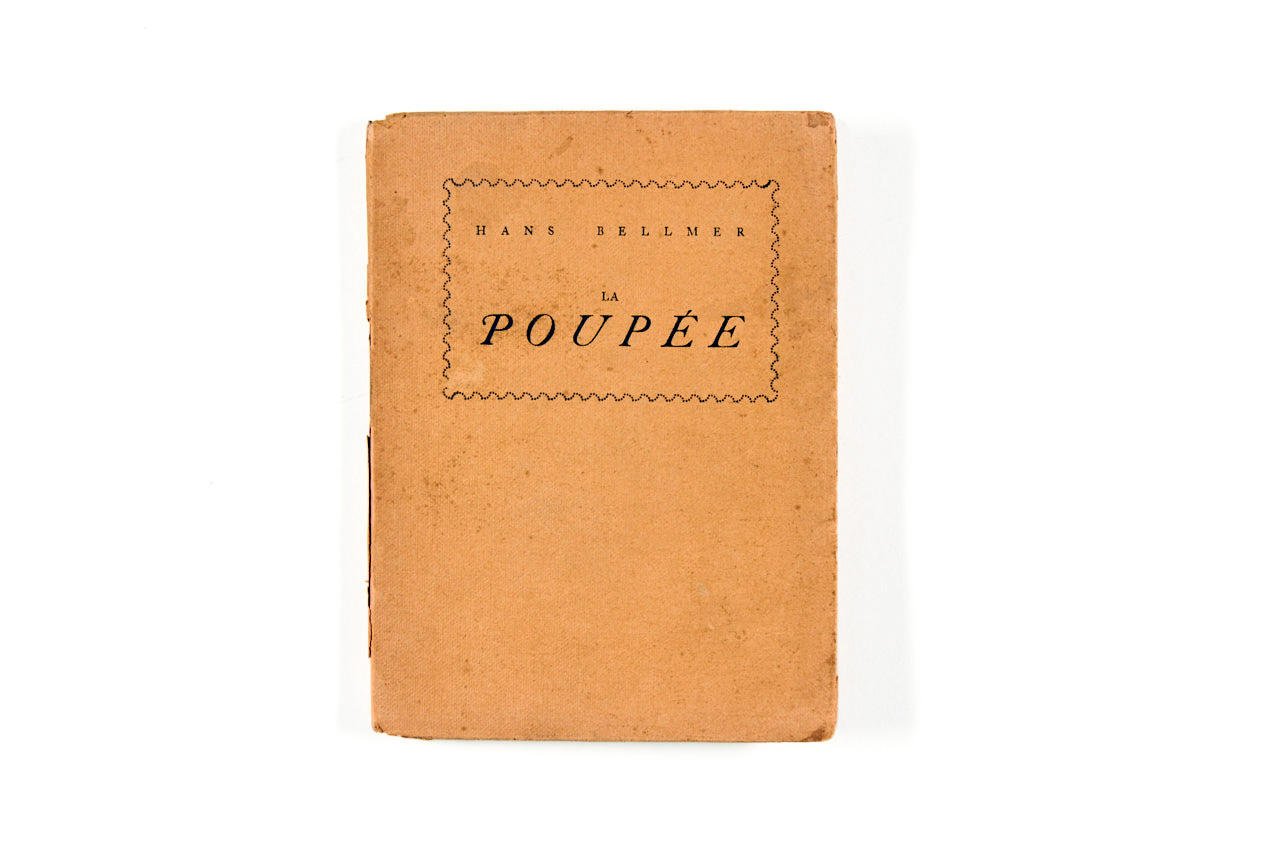
La Poupée (The Doll) / Hans Belmer, 1934
Surrealist fragmentation of the body – foundational for fetish imagery language.
Description
Hans Bellmer: The Doll
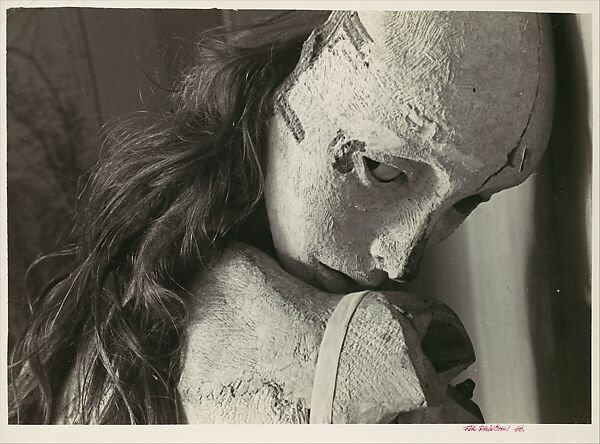
Hans Bellmer: The Doll is a photography book compiling the haunting and eroticized images of German artist Hans Bellmer’s life-sized female dolls, created between 1933 and the 1950s. The collection is recognized as a landmark of Surrealist and avant-garde photography, exploring desire, identity, and the fragmentation of the body.
Key facts
-
Artist: Hans Bellmer
-
First publication: 1934 (French edition La Poupée), expanded collections later
-
Genre: Surrealist photography / photobook
-
Publisher (notable edition): Grove Press (1960s English edition)
-
Themes: Eroticism, psychological dislocation, body manipulation
Origins and Concept
Bellmer began constructing articulated dolls in 1933 as a personal rebellion against Nazi ideals of bodily perfection and conformity. Each doll was a mutable figure, assembled and reassembled from interchangeable limbs, then photographed in unsettling poses. These photographs became the foundation for The Doll, first published as Die Puppe in Germany and later circulated in France as La Poupée among Surrealist circles.
Style and Imagery
Bellmer’s photographs employ theatrical lighting, fragmented compositions, and close-up views to transform the doll into an uncanny subject. The imagery blends eroticism and horror, presenting the body as both object and psychological projection. His techniques influenced Surrealist photographers such as Man Ray and the broader aesthetic of postwar avant-garde art.
Influence and Legacy
The Doll occupies a pivotal place in the history of photographic art and psychoanalytic modernism. It prefigured later explorations of gender, fetishism, and objectification in visual culture. Bellmer’s work, though controversial, remains a central reference for discussions of the uncanny and corporeal transformation in photography and contemporary art theory.
La Poupée evolved out of a series of events in Hans Bellmer’s personal life: his cousin, Ursula Naguschewski, moving from Kassel to Berlin in 1932; an encounter with renowned dollmaker Lotte Pritzel and his attendance of a performance of Jacques Offenbach’s Tales of Hoffmann, in which the protagonist falls in love with an automaton; and his mother shipping him his old toys.
Bellmer constructed several dolls, the first dating from 1933, which he assembled and photographed in strange and disquieting configurations. Ten of these photographs were published in Germany as Die Puppe (1934). It was Bellmer’s cousin Ursula who, while studying at the Sorbonne in 1934, apparently first brought Bellmer’s photographs to the attention of André Breton in Paris. In 1934, the Surrealist journal Minotaure published a portfolio of these images, and in 1936, one was published in an issue of Cahiers d’art devoted to the Surrealist object. Guy Levis Manos published this expanded French Edition with an introduction by Bellmer, translated by Robert Valencay. In February 1938, Bellmer left Berlin for Paris.
First edition, number 76 of 100 copies with 5 hors commerce, this being one of 80 copies on papier rose; (159 x 123 mm, 6¼ x 4¾ in); 10 mounted gelatin silver photographs (116 x 77 mm, 4½ x 3 in), text translated by Robert Valençay; pink wrappers, light wear, peach printed folding cover with titles on upper side in black, light wear to extremities and folds, a near-fine copy in a custom box by Devauchelle; [44]pp.


Reviews
There are no reviews yet.